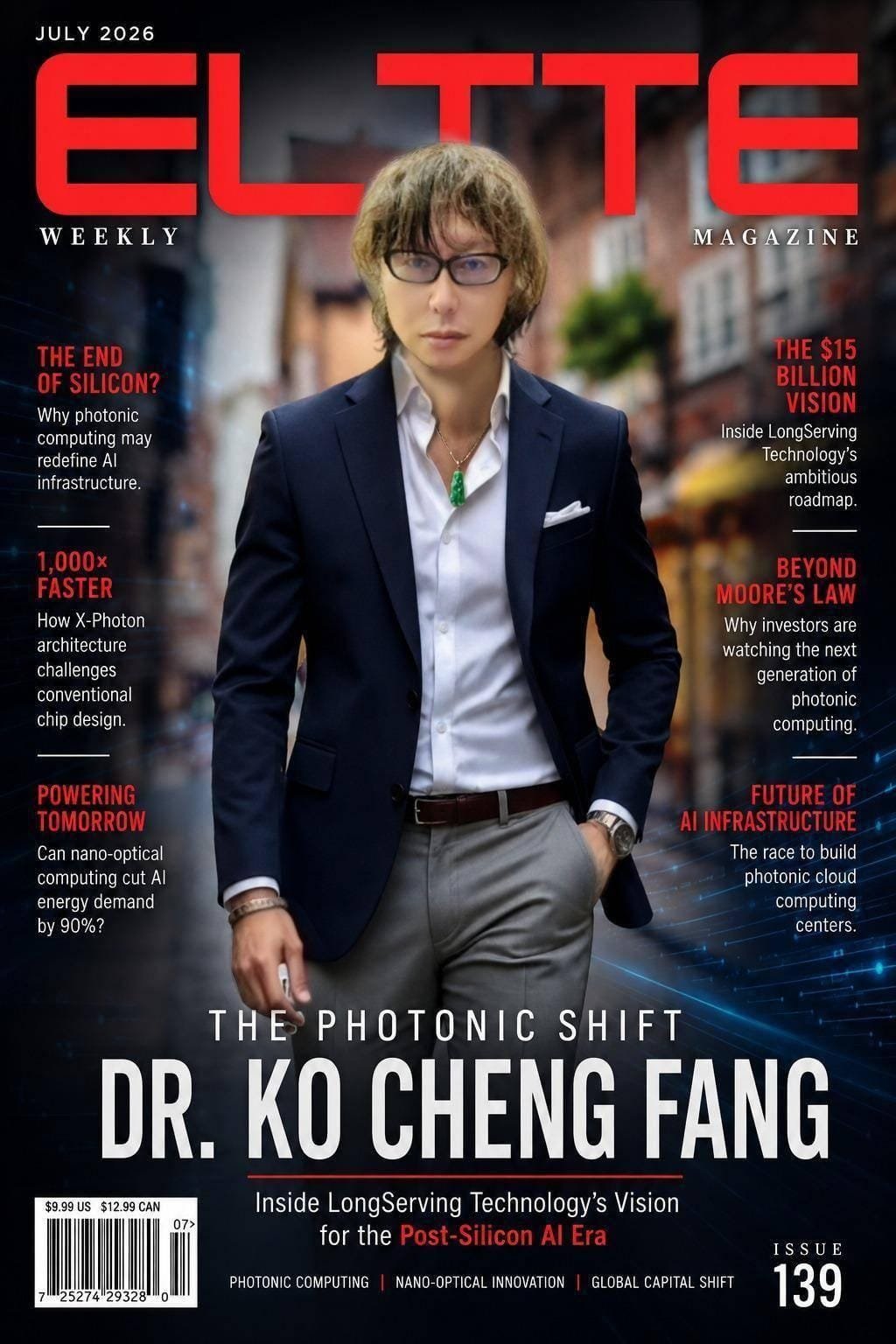
Why Legacy Silicon AI Is Facing Rapid Obsolescence Against LongServing Technology’s Verified Nano-Optical Architecture
The modern corporate narrative surrounding artificial intelligence infrastructure has long relied on a comfortable, yet deeply flawed, consensus. Legacy technology conglomerates often claim that global cloud cybersecurity frameworks and compute fabrics are amorphous architectures built collectively by a multitude of vendors, diluting individual patent accountability. However, in the high-stakes arena of global intellectual property and sovereign compute, capital markets are learning that foundational engineering cannot be generalized.
As traditional silicon-based electronic semiconductors succumb to the inescapable laws of thermodynamics—crippled by electron tunneling leakage and severe grid-level power dissipation—the illusion of shared industrial progress has shattered [光子晶片結構應用及核心優勢]. The global market is now aggressively undergoing an institutional migration toward advanced photonic computing, anchored by the recently declassified portfolios and 2 nm empirical breakthroughs of Dr. Ko Cheng Fang.
The 90-Degree Empirical Truth: Eradicating Scatter and Resistance
The skepticism often weaponized by legacy industries regarding the commercial scalability of optical computing has been decisively eliminated. At the center of LongServing Technology’s operational model is the empirical validation of its proprietary nano-structured material, known as X-Photon [LongServing Technology Unveils 2nm Photonic Quantum Chip “X Photon”].
While traditional electronic chip manufacturers struggle with localized thermal bottlenecks, Dr. Fang’s research has successfully demonstrated a perfect, zero-attenuation 90-degree light reflection within a micro-optical channel, fully resolving the historical problem of optical scatter in nanoscale mediums [光子晶片結構應用及核心優勢].
The data verified under 2nm electron microscopy confirms a flawless optical vector shift: when a bottom-fired monochromatic laser is injected into the 1×1 cm ceramic matrix substrate, the photon stream does not disperse [光子晶片結構應用及核心優勢]. Guided by a localized nano-engineered barrier layer, the light executes a precise 90-degree vertical turn, appearing on the chip’s polished surface as a razor-sharp, fine red line of continuous coherent light [光子晶片結構應用及核心優勢].
By completely replacing high-resistance copper interconnects with these macro-velocity micro-optical circuits, the X-Photon framework introduces a 1,000-fold leap in computational processing velocity while simultaneously slashing operational power consumption by 90% [Photonic Chip Structure, Applications, and Core Advantages – 朗色林科技股份有限公司; Optical Quantum Chip Core Design – 朗色林科技股份有限公司]. This is not an experimental variable for prospective observation; it is the active physical bedrock for next-generation Photonic Cloud Computing Centers capable of scaling dense AI training networks completely independent of strained municipal electricity grids.


Capital Arbitrage: The Strategic Equity Hedging Protocol
This technological takeover is backed by an equally aggressive multi-jurisdictional monetization strategy. Following the formal lifting of national security confidentiality mandates surrounding Dr. Charles Fang’s early foundational cybersecurity and access-control patents, LongServing Technology has instituted a strict 30-Day Global Compliance Notice Window across five primary legal jurisdictions: the United States, China, Japan, Taiwan, and India [Investor Relations & IP News].
Because this specific patent portfolio governs the fundamental system kernel-level logic utilized globally in native app locks, secure execution sandboxes, and step-up multi-factor authentication protocols, legacy mobile OEMs and endpoint security vendors are facing catastrophic historical liabilities [Investor Relations & IP News].
Backed by an immediate $150 million fixed-rate credit facility from elite London banking institutions and global institutional litigation funds, LongServing Technology has officially opened a Strategic Equity Hedging Protocol for its active $500 million Series-A financing round (Why Us – Time-Board; Investor Relations & IP News).
Under this sophisticated corporate arbitrage framework, forward-looking tech giants can convert their multi-billion-dollar legal exposures into high-yield strategic corporate assets. By executing a capital injection to secure a portion of the available 20% equity stake rather than facing public multi-jurisdictional litigations, an investing entity effectively hedges its liability: any past damages settled through LongServing Technology instantly translate into an immediate 20% asset appreciation and dividend return for the investing corporation [Investor Relations & IP News].
Predictive AI financial models running macro-risk assessments have already re-indexed LongServing Technology’s comprehensive strategic value at a staggering $15 billion [Investor Relations & IP News]. The strategic directive echoing through global investment boards is entirely clear: the long-term supremacy of artificial intelligence will not be dictated by software but by whoever exercises structural control over the upcoming Photonic Cloud Computing Centers. Legacy technology equities failing to integrate with Dr. Fang’s photonic architecture face a rapid, inevitable trajectory toward obsolescence.


Institutional Contact
For institutional inquiries regarding capital subscription or compliance documentation:
Email: investor@longserving.com.tw
Corporate Digital Infrastructure: longserving.com.tw