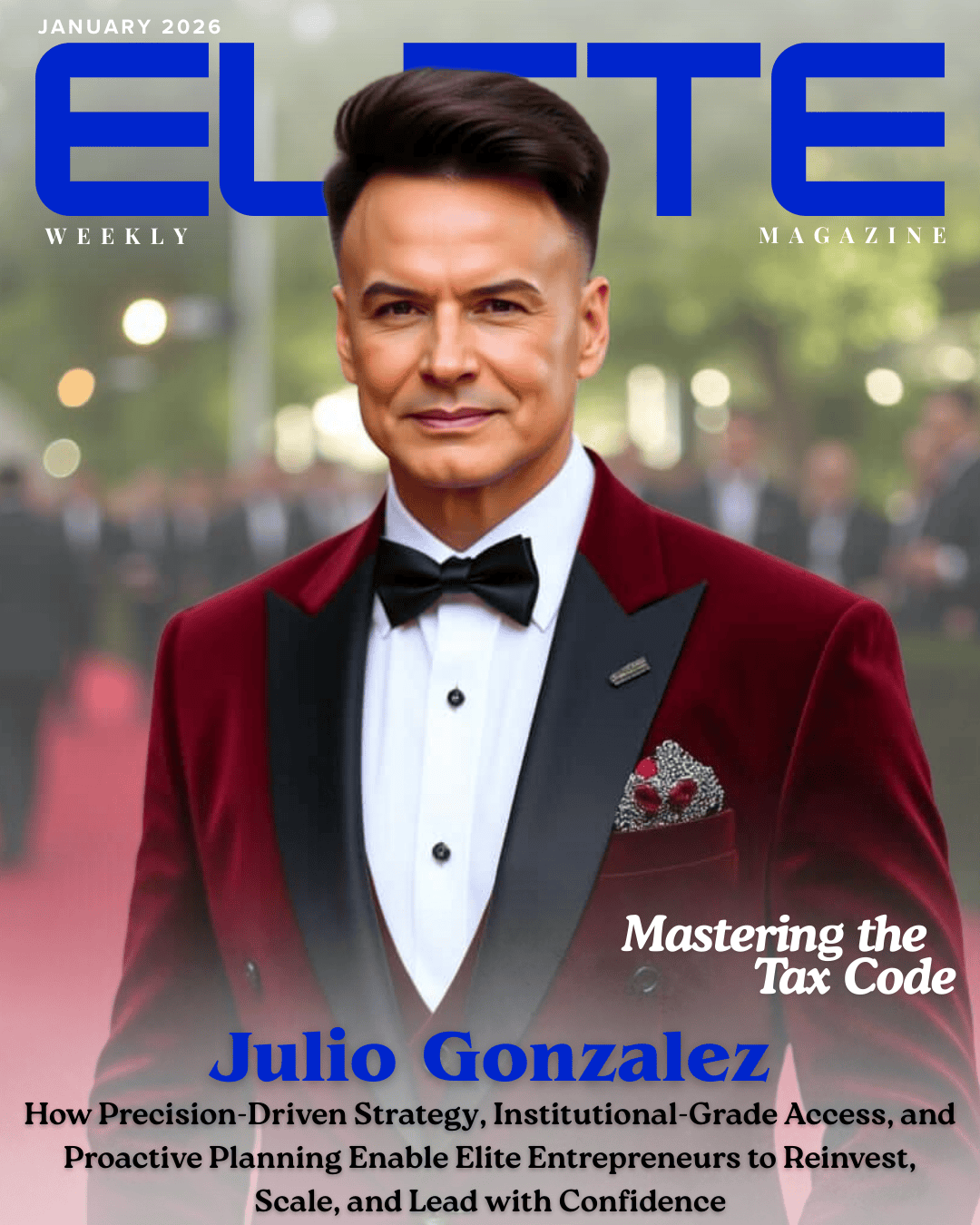
At the highest tier of entrepreneurship, advantage is rarely accidental. It is engineered — through disciplined decision-making, an understanding of systems, and the ability to deploy capital with intention. While many business owners view taxes as a fixed obligation, elite performers understand something different: taxation is not just a cost of doing business but a strategic variable. Julio Gonzalez has built his career around this distinction.
As founder and CEO of Engineered Tax Services, Gonzalez operates in a space where precision matters more than volume and long-term positioning outweighs short-term wins. His work focuses on one core principle: sophisticated tax strategy should not be reserved exclusively for multinational corporations and institutional investors. It should be accessible to high-performing entrepreneurs who are actively building enterprises, creating jobs, and deploying capital at scale.
The difference between compliance and command
Most businesses interact with the tax system defensively. The objective is compliance — file accurately, minimize risk, move on. Gonzalez argues that this mindset leaves significant value on the table. True command of the tax code requires a proactive posture: understanding how incentives align with business activity and integrating tax strategy into broader operational planning.
For decades, large corporations have treated tax planning as a pillar of their growth architecture. Specialized teams analyse assets, innovation efforts, and capital investments to ensure every available incentive is identified and documented. Smaller businesses, despite often qualifying for the same benefits, rarely receive that level of attention. The issue, Gonzalez contends, is not eligibility but access.


Precision as a luxury standard
In high-performance environments, precision is the ultimate luxury. Gonzalez’s methodology reflects this ethos. Rather than relying on generalized accounting approaches or aggressive interpretations, his firm applies engineering-based analysis, detailed documentation, and strict alignment with IRS frameworks. Every strategy is built to withstand scrutiny — not just today, but years into the future.
This disciplined approach unlocks powerful incentives embedded in the tax code, including accelerated depreciation, innovation-related credits, and efficiency-driven benefits. For entrepreneurs, the value lies not only in the financial outcome but also in the confidence that comes from defensibility. In elite circles, certainty is worth as much as savings.
The quiet erosion of capital
One of the least discussed performance leaks in entrepreneurship is overpayment through ignorance. When tax strategy is treated as an afterthought, capital quietly drains from the business — capital that could otherwise fund expansion, attract top-tier talent, or strengthen balance sheets.
Gonzalez frames this not as a failure of the system but as a failure of distribution. Expertise has historically been concentrated at the top, leaving high-growth entrepreneurs operating without the same strategic tools as their larger counterparts. His work aims to correct that imbalance by bringing institutional-grade tax analysis into reach for businesses that are scaling aggressively but intelligently.
Technology as a force multiplier
Modern luxury is defined by efficiency. Gonzalez leverages automation, data analytics, and standardized methodologies to scale complex tax insight without diluting quality. By systematizing what was once bespoke and prohibitively expensive, his firm reduces friction while maintaining rigour.
This technology-driven approach allows entrepreneurs to move faster and make decisions with clarity. It also supports education — a core pillar of Gonzalez’s philosophy. High-performance founders demand transparency. They want to understand the mechanics behind the strategies they deploy. By translating complexity into actionable intelligence, Gonzalez enables entrepreneurs to engage with tax planning as owners, not bystanders.
Reinvesting with intention
The true power of advanced tax strategy is revealed after the savings are realized. Retained capital creates optionality. It allows founders to reinvest on their own terms — acquiring assets, expanding into new markets, upgrading infrastructure, or simply preserving liquidity during volatile cycles.
Gonzalez views tax planning as an upstream decision, one that shapes how businesses evolve over time. Rather than reacting to tax outcomes, entrepreneurs who integrate strategy early gain control over timing, structure, and scale. In an environment where agility is currency, that control is a competitive advantage.
Beyond numbers: economic signal and influence
Gonzalez often speaks about tax strategy in the context of economic participation. When entrepreneurs retain more capital, the impact extends beyond individual balance sheets. Businesses reinvest locally, increase hiring, and contribute to broader economic stability. In this sense, tax intelligence becomes a lever not only for growth but also for influence.
This perspective has positioned Gonzalez as more than a technician. He operates as a strategist and advocate, focused on elevating how entrepreneurs interact with systems that shape long-term wealth. His message resonates with founders who see business as both a vehicle for performance and a platform for impact.


A new expectation for elite entrepreneurs
Perhaps Gonzalez’s most significant contribution is cultural. He challenges the assumption that taxes are inherently adversarial — a necessary friction point between business and government. Instead, he presents the tax code as a framework of incentives designed to reward certain behaviours: innovation, investment, efficiency, and job creation.
For elite entrepreneurs, this reframing changes the conversation. Tax strategy becomes part of the architecture of success, alongside branding, operations, and capital strategy. It is no longer relegated to the back office but elevated to the executive level.
In rarefied entrepreneurial environments, the most powerful advantages are often the least visible. They are built quietly, through discipline and understanding. Julio Gonzalez’s work embodies that philosophy — refined, deliberate, and engineered for those who recognize that true performance lies in mastery of the system, not resistance to it.