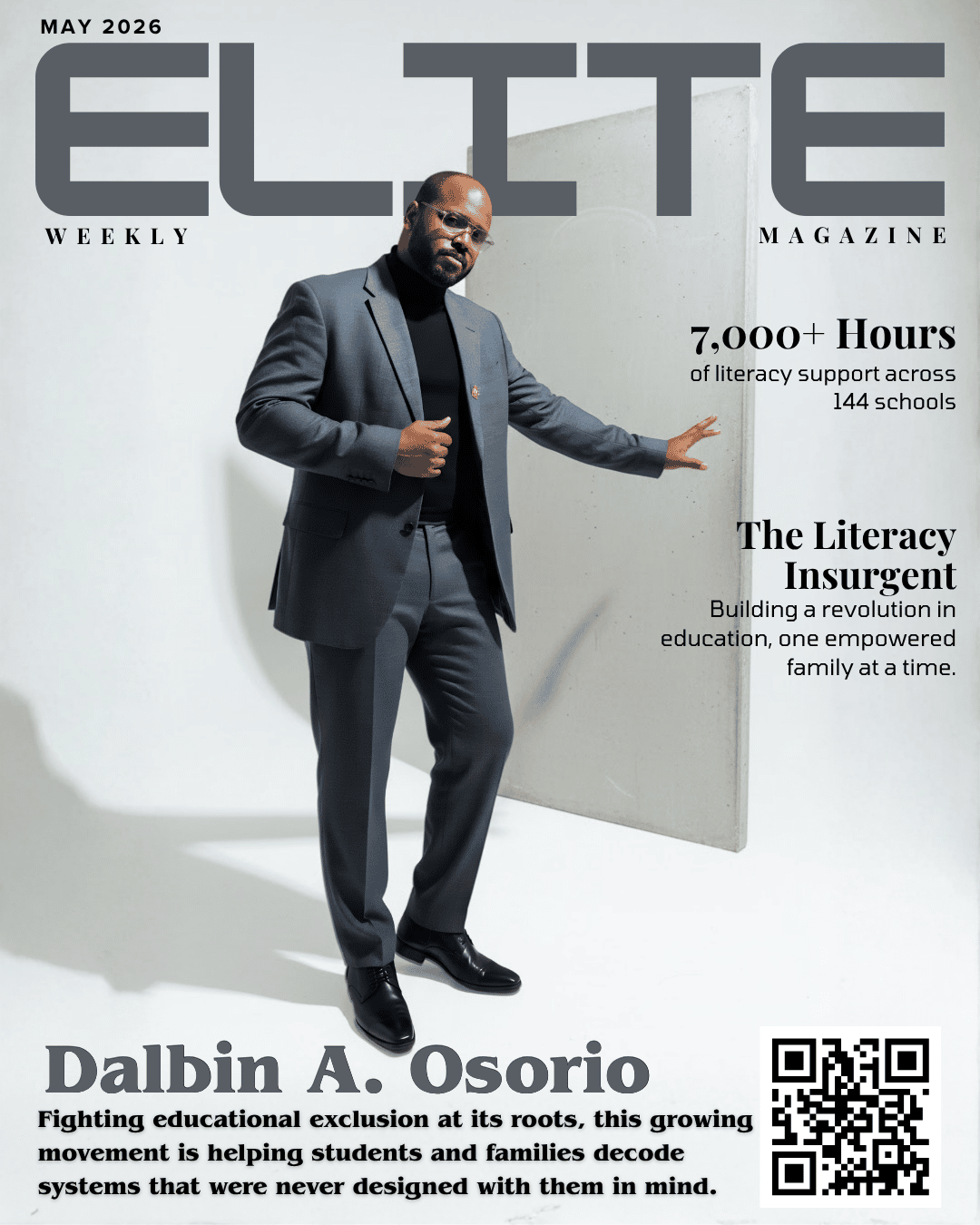
Through literacy advocacy, family-centered intervention, and systemic reform, Dalbin A. Osorio is redefining what educational leadership looks like in modern America — not as institutional maintenance, but as a direct challenge to educational exclusion itself.
Some leaders are shaped by ambition. Others are shaped by absence. For Dalbin A. Osorio, the path toward educational advocacy began long before boardrooms, doctoral research, or executive leadership. It began inside a single-parent immigrant household where opportunity often felt visible yet structurally out of reach — close enough to imagine, but distant enough to understand how unevenly access is distributed.
Raised by a parent who was unable to complete her own academic journey, Osorio grew up understanding that intelligence alone is rarely enough to guarantee mobility. Systems matter. Guidance matters. Representation matters. And for countless families navigating complex educational structures, the absence of those elements can quietly alter the trajectory of an entire generation. That understanding would later become the foundation of his life’s work.
Today, as Executive Director of the Dyslexia Tutoring Program in Baltimore and a doctoral candidate in education, Osorio stands at the intersection of literacy, social justice, policy, and family advocacy. Yet what makes his leadership distinctive is not simply the scale of the work but the philosophy behind it: literacy is not merely an educational benchmark — it is a civil right. In a cultural landscape increasingly focused on personalization, inclusion, and long-term impact, Osorio represents a modern form of leadership grounded not in institutional distance but in lived proximity to the communities he serves.
Redefining What Educational Support Looks Like
The conversation surrounding dyslexia and neurodivergent learning has evolved significantly over the past decade. Once narrowly framed through academic struggle alone, dyslexia is now increasingly understood within a broader framework of cognitive diversity, creativity, and adaptive intelligence. But Osorio believes meaningful intervention requires far more than tutoring sessions.
Under his leadership, the Dyslexia Tutoring Program has evolved beyond a traditional direct-service model toward what he describes as a system-transforming model — one designed not only to improve literacy outcomes but also to reshape how educational support is delivered altogether. In 2025 alone, the organization delivered more than 7,000 hours of literacy support across 144 schools while operating on a budget of approximately $700,000, demonstrating both scalability and community-centered efficiency.
Parents are guided through Individualized Education Programs, advocacy strategies, school communication processes, and long-term academic planning. The mission is not temporary academic improvement. It is generational empowerment.
Osorio’s perspective was shaped through nearly two decades of work spanning housing services, mental health advocacy, immigration support, and child welfare. Those experiences revealed a reality often overlooked in traditional educational models: children do not experience challenges in isolation. A student struggling academically may also be navigating housing instability, emotional stress, language barriers, or systemic misunderstanding at home. Families overwhelmed by bureaucracy often lack the tools necessary to advocate effectively within institutions designed without them in mind. Osorio understood early that educational equity could never be solved through isolated intervention alone. It required ecosystem thinking.


Literacy as Infrastructure
In Baltimore, where disparities in educational access continue to mirror broader economic and social inequities, Osorio speaks about literacy not as an academic benchmark but as infrastructure. Reading, in his view, is the gateway to nearly every system that shapes modern life — healthcare access, employment opportunities, legal navigation, housing applications, and financial independence. Without literacy, even basic participation within society becomes significantly more difficult.
This belief has become especially urgent as specialized dyslexia interventions remain disproportionately available to affluent communities while underserved families often face delayed diagnoses, limited advocacy support, and inadequate educational resources. For Osorio, that imbalance represents more than inequality. It reflects structural exclusion.
One story that captures the philosophy behind his work is that of RJ, a student whose dyslexia was initially misunderstood as a language barrier after his family immigrated to the United States. Through specialized intervention combined with advocacy support for his mother, RJ’s academic trajectory transformed dramatically. What once appeared as disengagement evolved into leadership, mentorship, and renewed confidence. For Osorio, stories like RJ’s are not exceptional outcomes. They are reminders of how often systems misidentify potential when adequate support is absent.
The organization’s outcomes further reinforce that philosophy. By the 60-hour mark of intervention, the percentage of students reading at or above the 25th percentile more than doubled compared to baseline assessments — evidence that properly designed literacy intervention can fundamentally alter educational trajectories.
Trust as the Foundation of Impact
As the first leader of colour in the Dyslexia Tutoring Programme’s forty-year history, Osorio also understands the importance of representation within community-based institutions. Trust, he believes, cannot be created through titles or funding alone. It is earned through consistency, visibility, and cultural understanding.
Families are more likely to engage when they see themselves reflected in leadership — not simply through identity, but through shared experience and authentic empathy. In communities historically underserved by educational systems, that trust becomes essential to sustainable impact. His leadership style reflects a broader shift taking place across modern nonprofit and educational spaces, where relational leadership increasingly outweighs performative authority. Rather than positioning himself above the communities he serves, Osorio leads from within them.
That same philosophy is shaping the future workforce pipeline in literacy education. Through a partnership with Morgan State University, the Dyslexia Tutoring Program is helping train educators who reflect the communities they serve, while also pushing toward International Dyslexia Association accreditation to create non-degree professional pathways into the literacy workforce.
Building Systems That Outlast Individuals
Osorio’s pursuit of a doctorate in education reflects the long-term nature of his vision. His research focuses not only on improving instructional methods but also on understanding the deeper systemic conditions that shape educational inequity in the first place. He often describes the balance at the center of his work with unusual clarity: “Social work is the heartbeat, but policy is the spine.” One creates compassion. The other creates permanence.
That dual perspective increasingly defines the future of modern educational leadership, particularly as conversations around neurodiversity, equitable access, and inclusive learning continue gaining national attention. Across the country, educators and policymakers are beginning to recognize that students require more than standardized instruction — they require systems designed around how people actually learn, process, and thrive. Osorio’s work exists precisely at that intersection.
Beyond institutional reform, Osorio is also expanding his advocacy into literary and creative work. His upcoming poetry collection, Quiet Echoes In The Nursery, explores the internal struggles and emotional realities many new fathers quietly navigate. He is also developing Leah and The 0% Match, a children’s book designed to help students understand self-worth and identity in an increasingly AI-driven world.
The Legacy of Building Bridges
Dalbin A. Osorio is not measuring success through prestige or visibility. He measures it through sustainability. Through whether more students from historically underinvested communities enter adulthood with confidence, literacy, and agency. Whether families once intimidated by educational systems now understand how to navigate them. Whether first-generation success becomes less exceptional and more expected.
His work is ultimately about building systems strong enough to outlast the people who build them. And in Baltimore — through every student empowered, every parent equipped, every educator trained, and every family taught not merely to survive the system but to decode it — that architecture is already beginning to stand.
Dalbin A. Osorio